Search for a scope creep management tool and you'll find two kinds of advice: templates ("keep a change log!") and project management suites that let you document scope changes after they've already eaten your week. Neither one stops the creep — they just help you write its obituary.
What scope creep management actually requires
Scope creep isn't a documentation problem. It's a detection problem. The expensive requests don't arrive labeled as change requests — they arrive as friendly one-liners in WhatsApp, Telegram threads and Jira comments, phrased so casually that saying no feels rude and logging a change request feels bureaucratic.
So a tool that manages scope creep has to do three things, in this order:
- Sit where the requests happen. If clients ask in chat and your scope lives in a PDF, no workflow will connect them. The tool has to read the chat.
- Know what was agreed. Not a one-line project description — the actual scope of work, with deliverables and acceptance criteria, parsed and indexed so a new request can be compared against it.
- Decide at the moment of the ask. In scope → answer with status. Out of scope → flag it, estimate it, and put a decision in front of the PM before anyone says yes by accident.
Why the usual options fall short
Project management suites (Jira, Asana, Monday) track the work you've agreed to do. They have no opinion about whether a new request belongs there — anything typed into the board becomes work. The creep is already inside.
Change request templates rely on the client filing paperwork for something they think is small. They won't, and asking them to feels like friction on your side.
Time tracking tells you the damage in the retro, weeks later. By then it's unbilled work you either eat or fight about — we broke down what that costs a typical agency, and it's not a rounding error.
What it looks like when it works
The scope of work gets uploaded once, parsed into scope items and acceptance criteria. Then every incoming client request — in chat or on the board — is classified against it: in scope, partial, or out of scope, with the evidence attached. Out-of-scope asks come with a suggested story and a rough effort bucket, so the PM's job shrinks to a yes/no with a price instead of an investigation.
The client gets an instant, honest answer either way:
That sits outside the agreed scope, so I've flagged it to your PM — we can pencil it in for the next sprint.
No awkward call. No silent margin erosion. And because the requests start in chat, that's where the guard has to live.
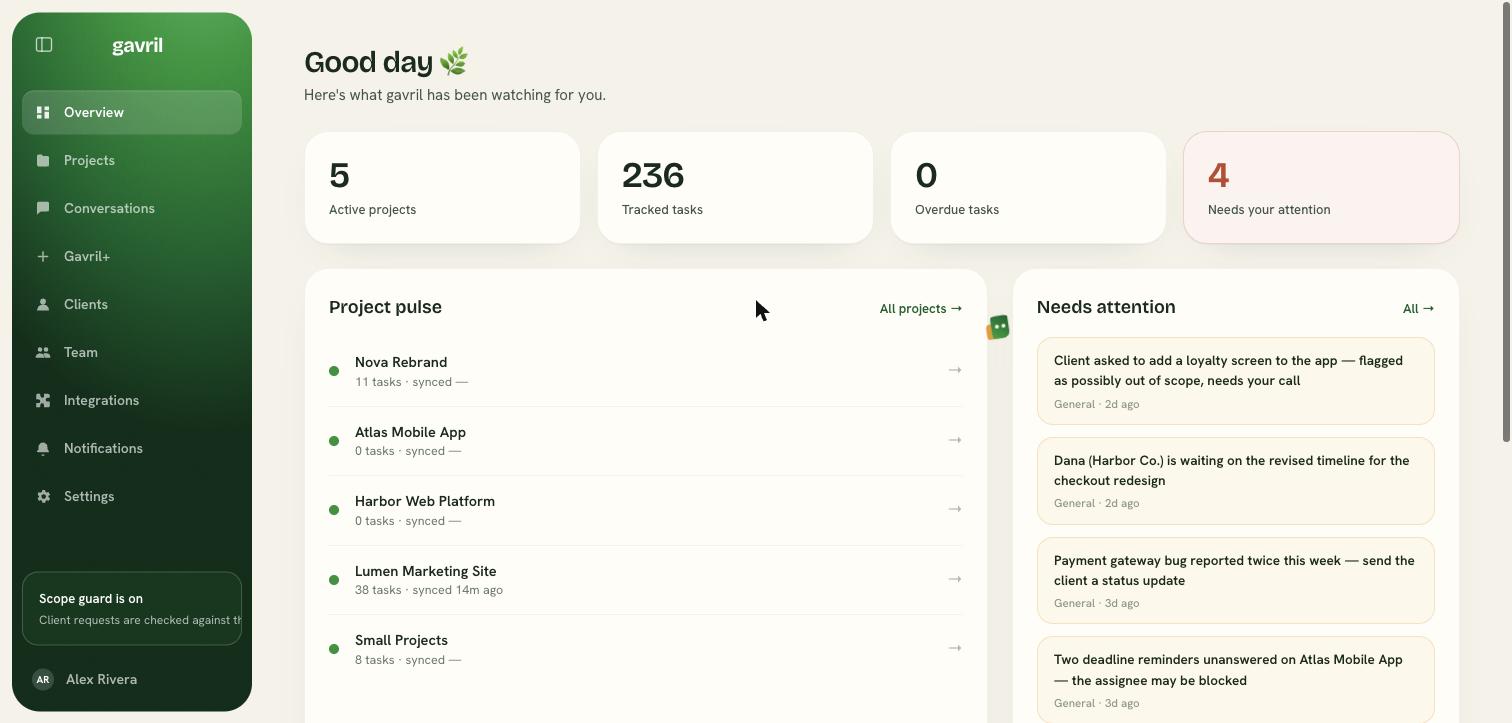
That's the design behind Gavril's scope guard: an AI project manager that reads the client conversation, checks every ask against the signed scope of work, and answers — or escalates — in the same thread.
← All posts